If you’re specifying high-current single-pole connectors, you’ll frequently encounter the terms source, drain, line and panel.
These terms are commonly used across the Powersure LSP range — and indeed most Powerlock-style connection systems. They can be confusing at first — particularly if you’re more familiar with describing electrical connections simply as plugs and sockets.
The important point is that they describe two different things:
- Source and drain describe the electrical contact arrangement and which side of the connection supplies power.
- Line and panel describe the physical format of the connector.
Once those two distinctions are separated, the terminology becomes considerably easier to understand.
What is a source connector?
A source connector is used on the side of a connection supplying electrical power.
In the Powersure LSP system, the source connector has a male electrical contact housed within a female insulator.
The contact itself incorporates an insulated nose to help protect against accidental contact, with the LSP system designed to provide IP2X finger protection.
What is a drain connector?
A drain connector is the mating connector on the side receiving power from the source.
It uses the opposite arrangement: a female electrical contact housed within a male insulator.
Source and drain connectors are therefore complementary. A source mates with a drain; two source connectors or two drain connectors are not intended to mate with one another.
This terminology is widely used across high-current locking single-pole connector systems, including products commonly described as Powerlock-type connectors.
Is a source simply another word for a plug?
Not quite.
This is where much of the confusion comes from.
With an ordinary domestic connection, we tend to think in terms of a plug on the cable and a socket on the appliance or wall.
High-current single-pole connector systems make another distinction:
- A line connector is fitted to a cable.
- A panel connector is mounted to a piece of equipment, enclosure or distribution panel.
Either of those can be a source or a drain.
That gives us four possible connector types:
|
Connector |
Where it is fitted |
Contact type |
|
Panel Source |
Equipment or panel |
Male contact |
|
Line Drain |
Cable |
Female contact |
|
Line Source |
Cable |
Male contact |
|
Panel Drain |
Equipment or panel |
Female contact |
So describing one simply as a “plug” or “socket” can leave out an important part of the specification.
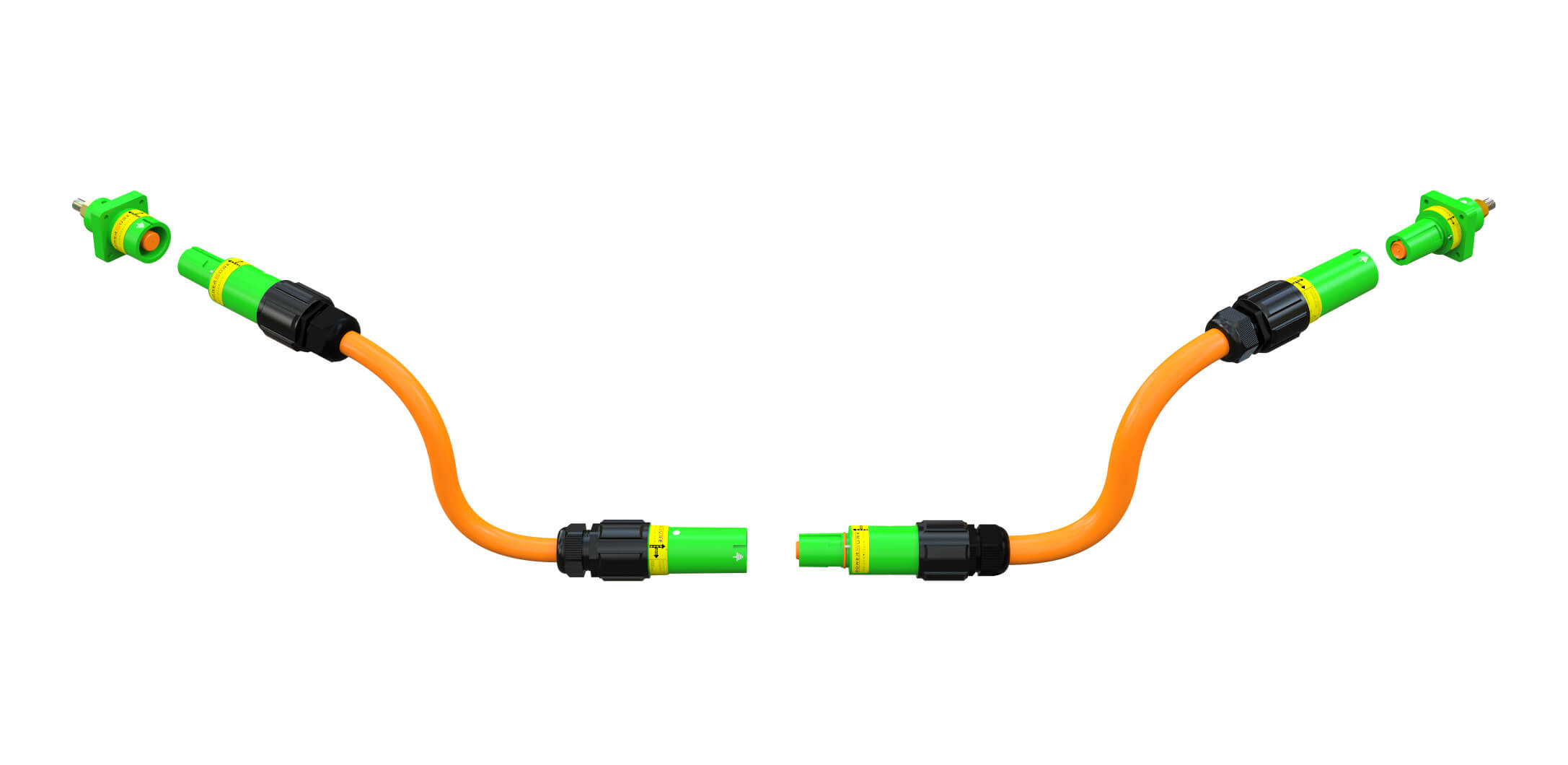
A typical source-to-drain connection
Consider a generator and load bank connected as part of a temporary testing setup.
The generator might be fitted with a Panel Source connector.
The cable connecting to it therefore needs a Line Drain connector.
At the other end of the cable is a Line Source connector, which then connects to a Panel Drain on the load bank.
The arrangement looks like this:
GENERATOR / POWER SOURCE
Panel Source ⇄ Line Drain — CABLE — Line Source ⇄ Panel Drain
EQUIPMENT / LOAD
Thinking in terms of the energising side and receiving side of each connection makes the source/drain naming much easier to follow.
Why use source and drain terminology?
At the currents involved in temporary power, generators, load banks, switchgear and other industrial applications, connector terminology needs to convey more than whether something superficially resembles a plug or socket.
Source/drain identifies the electrical arrangement.
Line/panel identifies how and where the connector is installed.
Together, those terms allow the required connector to be specified much more precisely.
For example, asking for a 500A Line Drain tells us considerably more than simply asking for a “500A socket”.
Source and drain connectors in the Powersure LSP range
Triangle Cables are the official global distributors of the Powersure LSP range of high-current locking single-pole connectors. They’re available in both line and panel-mounted formats, each with source and drain versions.
The range includes 500A connectors for single-core cables from 25 mm² to 150 mm² and 800A connectors for cables from 150 mm² to 300 mm², together with different termination and insulator options.
The LSP system is mechanically keyed and colour coded, incorporates a secondary locking mechanism and is designed for compatibility with established Powerlock- and Powersafe-type connection systems.
If you already know the connector type you require, the four terms — Panel Source, Line Drain, Line Source and Panel Drain — should make specifying it straightforward.
If you know the application but are not certain which connector, cable size or termination you need, speak to the Triangle team. We can work from the equipment and application and help determine the appropriate configuration.