H07RN-F is a familiar cable designation across industry, with several manufacturers producing products to the relevant harmonised standards.
It’s widely specified, widely available and well suited to a broad range of flexible power applications.
Our Sureflex EC cable occupies some of the same territory, but it’s built rather differently.
For applications where cable size, weight, flexibility and current-carrying capacity have a practical effect on the job, those differences can become significant.
That doesn’t make H07RN-F the wrong cable, nor Sureflex EC the right cable in every case. Cable selection ultimately depends on the electrical requirements, installation method, environment and application.
The useful question is therefore not simply which cable is “better”, but:
When two cables are being considered for similar work, what do the differences between them actually mean in practice?
Comparing 150 mm² Sureflex EC against the published specifications of a commercially available 150 mm² H07RN-F cable gives us a useful place to start.
It’s worth remembering that H07RN-F is a cable designation rather than a single manufacturer’s product. Although cables produced under this designation share prescribed characteristics, individual products can differ in dimensions, weight and published operating specifications.
The figures in our comparison therefore relate to one example of H07RN-F, rather than every cable available under that designation.
The Differences at a Glance
Take a look at the two 150 mm² cables. At the same nominal cross-sectional area, they differ considerably in their published specifications. We’ve also included a 120 mm² Sureflex EC cable for further comparison.
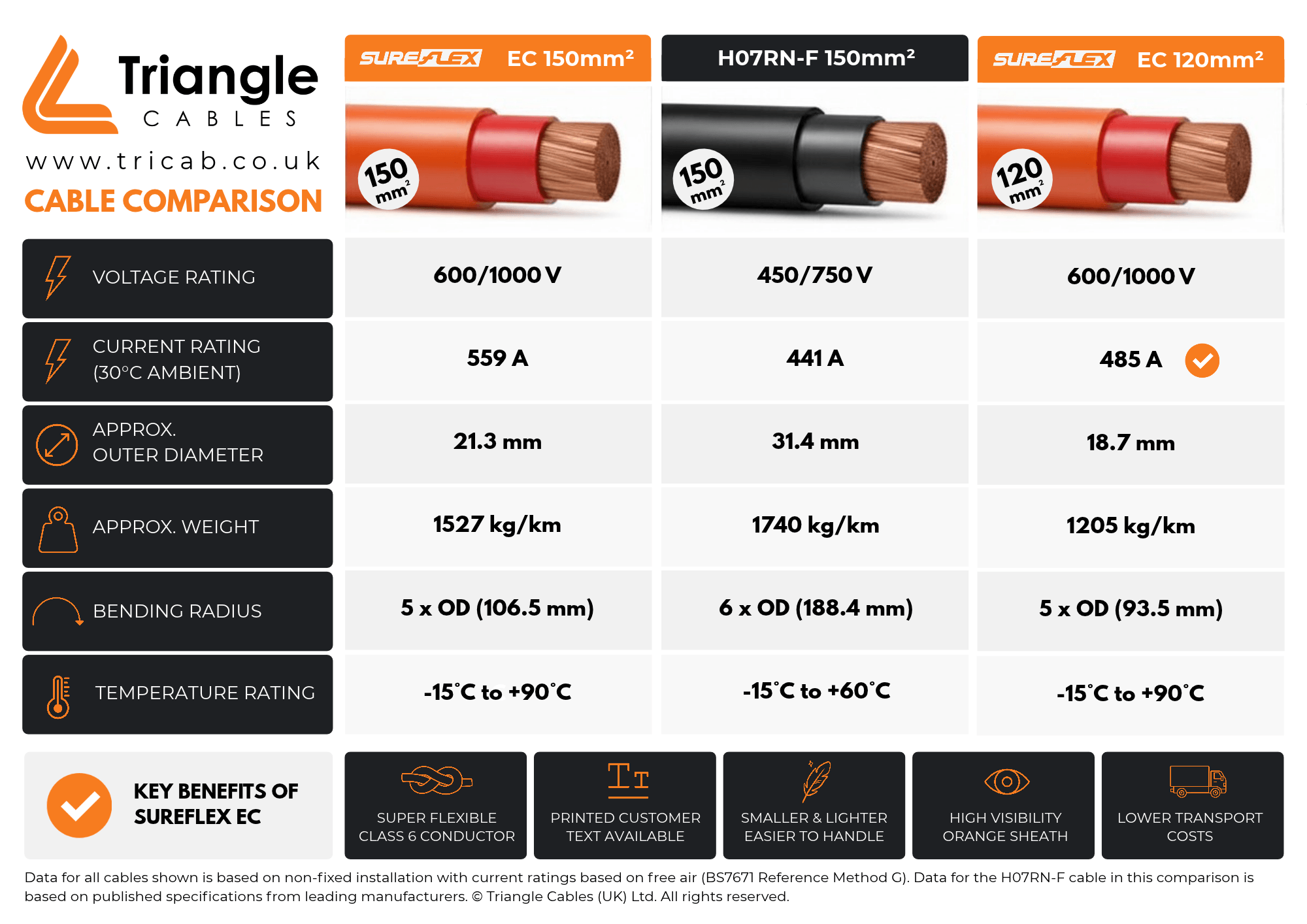
The difference isn’t simply one of flexibility.
At 150 mm², Sureflex EC is smaller in overall diameter, lighter, capable of a tighter permissible bend and carries a higher published current rating under the comparison conditions shown.
Those figures begin to matter when the cable has to be routed through equipment, brought onto terminals, installed in confined spaces, moved repeatedly or transported in quantity.
Higher Current-Carrying Capacity at the Same CSA
At 150 mm², Sureflex EC has a published current rating of 559 A at 30°C ambient, compared with 441 A for the H07RN-F cable in our comparison.
That gives EC considerably more capacity at the same nominal conductor size. For a 400 A application, for example, both cables remain within their published ratings, but the operating current sits much further below the rating of the EC cable.
The comparison becomes more interesting when we look beyond like-for-like conductor sizes.
Sureflex EC at 120 mm² is rated at 485 A at 30°C ambient conditions. That’s still higher than the 441 A rating of the 150 mm² H07RN-F cable.
The published figures suggest that, in the right application, a smaller Sureflex EC conductor may be worth considering. That could carry practical advantages of its own, particularly where cable diameter, weight and routing space matter.
Of course, we need to be very careful with this comparison.
The Sureflex EC ratings shown are based on BS 7671 Reference Method G, while the 441 A H07RN-F rating comes from a manufacturer’s published free-air specification. These do not describe identical installation arrangements, so the figures alone cannot establish whether one cable size can safely replace another.
Current-carrying capacity is only one part of cable selection. Voltage drop, short-circuit withstand, installation method, grouping, ambient conditions, terminations and applicable standards must also be considered.
Smaller Cable Can Simplify Installation
At 150 mm², Sureflex EC has an approximate outer diameter of 21.3 mm, compared with 31.4 mm for the H07RN-F cable in our comparison. It’s also lighter, at approximately 1,527 kg/km compared with 1,740 kg/km.
Those differences matter wherever space and handling become part of the installation.
A smaller overall diameter means less cable to route through openings, around components and alongside other conductors. In switchgear, generators, load banks and similar equipment, that can be especially useful where several large cables need to occupy the same enclosure.
Lower weight helps for the same reason. Large conductors become physically demanding to lift, position and dress into place, particularly where several runs are being installed together.
At 150 mm², the difference is 213 kg per kilometre. Over a 100 m length, that is roughly 21 kg less cable to handle.
The advantage is therefore not simply a smaller number on the datasheet. It’s less bulk and less weight to accommodate during installation.
Why Bending Radius Matters in Confined Spaces
Flexibility becomes most useful when it can be expressed in practical installation terms, and bending radius is one of the clearest measures.
At 150 mm², Sureflex EC has a minimum bending radius of 5 × overall diameter, giving approximately 106.5 mm. The H07RN-F cable in our comparison is shown at 6 × overall diameter, or approximately 188.4 mm.
That’s a substantial difference in the space required for the cable to change direction.
In a straightforward open run, it may matter very little. Inside switchgear, generators, load banks and other compact assemblies, it can be much more significant.
A cable that reaches its permissible bend within a smaller space is easier to route around components and bring onto terminals where enclosure space is limited.
The smaller overall diameter of Sureflex EC strengthens that advantage. The bend ratio is tighter, and the cable itself is smaller, so the resulting minimum bend is considerably smaller in absolute terms.
Of course, the specified minimum bending radius must still be respected. The advantage is simply that Sureflex EC can achieve its permissible bend within less space.
Construction and Operating Characteristics
Some of the differences in performance and handling come from the construction of Sureflex EC itself.
Sureflex EC is a single-core, double-insulated 0.6/1 kV cable with flexible XLPE insulation and a modified PVC-NBR outer sheath. It is rated for operation from -15°C to +90°C and is flame retardant, with resistance to water, oil, UV and ozone.
Sizes from 6 mm² to 300 mm² use a Class 6 flexible copper conductor, with Class 5 construction used from 400 mm² upwards.
There is also a useful detail for visual inspection: The outer sheath and insulation beneath it use contrasting colours, so cuts or abrasion that penetrate the sheath can be easier to identify.
That does not replace proper inspection or testing, but where cables are regularly handled or moved, making physical damage more obvious is always a practical advantage.
Where the Differences Matter Most
The advantages of Sureflex EC are most relevant where the cable itself becomes part of the installation problem.
In switchgear, large conductors may need to be routed through confined enclosures and brought neatly onto terminals. Reduced diameter and a tighter bending radius can make that easier.
In generators and load banks, substantial currents often need to be accommodated within compact equipment, so cable size and routing space can become important design considerations.
For temporary power, repeated deployment and recovery place more emphasis on handling. Lower weight and greater flexibility can make the cable easier to move, position and recover.
In each case, the practical value comes from the same underlying point: less bulk, less weight and a tighter permissible bend can make the cable easier to incorporate into the equipment or installation.
When H07RN-F May Still Be the Right Choice
H07RN-F remains a sensible choice in many applications.
If space is generous, handling requirements are modest, weight is not a particular concern and the required current sits comfortably within the selected cable size, some of the advantages of Sureflex EC may simply matter less.
There is also value in familiarity. H07RN-F is widely understood and may already be incorporated into proven designs, purchasing systems and maintenance procedures.
Where the existing specification works well and meets the requirement, changing it for the sake of it may achieve very little.
That is why we do not regard Sureflex EC as a universal replacement for H07RN-F. The more useful question is whether the application benefits from what EC does differently.
Choosing From the Application Backwards
The comparison we’re making here is ultimately less about deciding which cable is “best” than understanding what the application requires.
Current-carrying capacity, cable diameter, weight, bending radius and operating conditions all contribute to that decision. In some applications, the higher current-carrying capacity of Sureflex EC can mean that a smaller conductor size still meets the required load. In our comparison, for example, 120 mm² Sureflex EC is rated at 485 A, compared with 441 A for 150 mm² H07RN-F.
The practical approach is to start with the job itself: the load, available space, routing, handling requirements and operating environment.
Once those are understood, the specification becomes much easier to evaluate.
If you know exactly what you require, the technical data will usually tell you most of the story. If you know the application but are less certain about conductor size, construction or suitability, our team can help work through those decisions before an order is placed.
The right cable is the one that fits the electrical requirement, the installation and the way the equipment will actually be used.